As we arrived at the site Tuesday afternoon, I was feeling both nervous and excited as I did not know what to expect, in terms of excavation and what types of artifacts and features we would be finding. As soon as the entire crew arrived on site, Mike Meyer and Erica Gibson oriented us to the project and to what the goals of the excavation were.
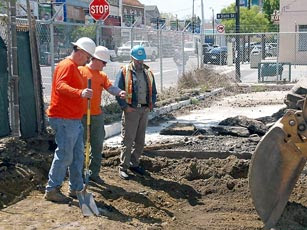 Meyer pointed out that the numbers that were spray painted in red on the cement were actually addresses from the houses and buildings that once made up Heinlenville. It is slightly daunting to know that just beneath the asphalt upon which you are standing, someone’s house or businesses once stood. After the initial orientation, he pointed to the trench that was just beginning to be cleared out by the backhoe and gave us the go ahead to start grabbing shovels, hoes, hard hats and safety vests.
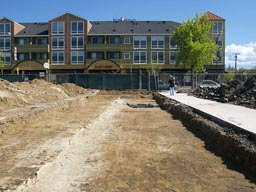 The backhoe was able to clear out the big chunks of fill and it was our job to sort of clean up after the backhoe and to get the rest of the gravel and loose dirt out of the trench and scrape down to the clay to expose any features. This particular trench was actually exposing buildings that were actually the beginnings of Japantown. It’s a little scary to work right across from the backhoe and you learn pretty quickly how to make eye contact with its operator so you don’t get knocked unconscious by getting hit with the bucket. Luckily Mike Stoyka was there to keep an eye on us and to sort of help to run interference between us and the heavy machinery.
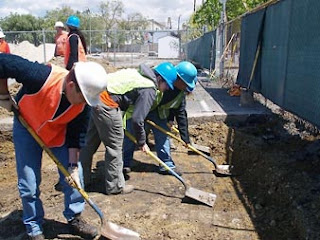 Adrian also had to give myself and a couple of the other newer members of the crew lessons in shoveling. There’s definitely an “art form” to shoveling, and a method that is supposed to help to keep us from getting too tired out so they can get more work out of us.
As we moved down through the trench it was exciting to see some artifacts being uncovered beneath a mass of dirt and gravel. Shoveling and scraping the clay was probably fun for about the first hour, but, by the end of the first day, all of us were pretty tired, and we hadn’t even finished the entire first trench yet.
 Meyer pointed out that the numbers that were spray painted in red on the cement were actually addresses from the houses and buildings that once made up Heinlenville. It is slightly daunting to know that just beneath the asphalt upon which you are standing, someone’s house or businesses once stood. After the initial orientation, he pointed to the trench that was just beginning to be cleared out by the backhoe and gave us the go ahead to start grabbing shovels, hoes, hard hats and safety vests.
 The backhoe was able to clear out the big chunks of fill and it was our job to sort of clean up after the backhoe and to get the rest of the gravel and loose dirt out of the trench and scrape down to the clay to expose any features. This particular trench was actually exposing buildings that were actually the beginnings of Japantown. It’s a little scary to work right across from the backhoe and you learn pretty quickly how to make eye contact with its operator so you don’t get knocked unconscious by getting hit with the bucket. Luckily Mike Stoyka was there to keep an eye on us and to sort of help to run interference between us and the heavy machinery.
 Adrian also had to give myself and a couple of the other newer members of the crew lessons in shoveling. There’s definitely an “art form” to shoveling, and a method that is supposed to help to keep us from getting too tired out so they can get more work out of us.
As we moved down through the trench it was exciting to see some artifacts being uncovered beneath a mass of dirt and gravel. Shoveling and scraping the clay was probably fun for about the first hour, but, by the end of the first day, all of us were pretty tired, and we hadn’t even finished the entire first trench yet.
Annamarie Guerrero
Graduate Student
Graduate Student


